The 50/30/20 Budgeting Rule for UPI Users: Why Traditional Budgeting Breaks in India
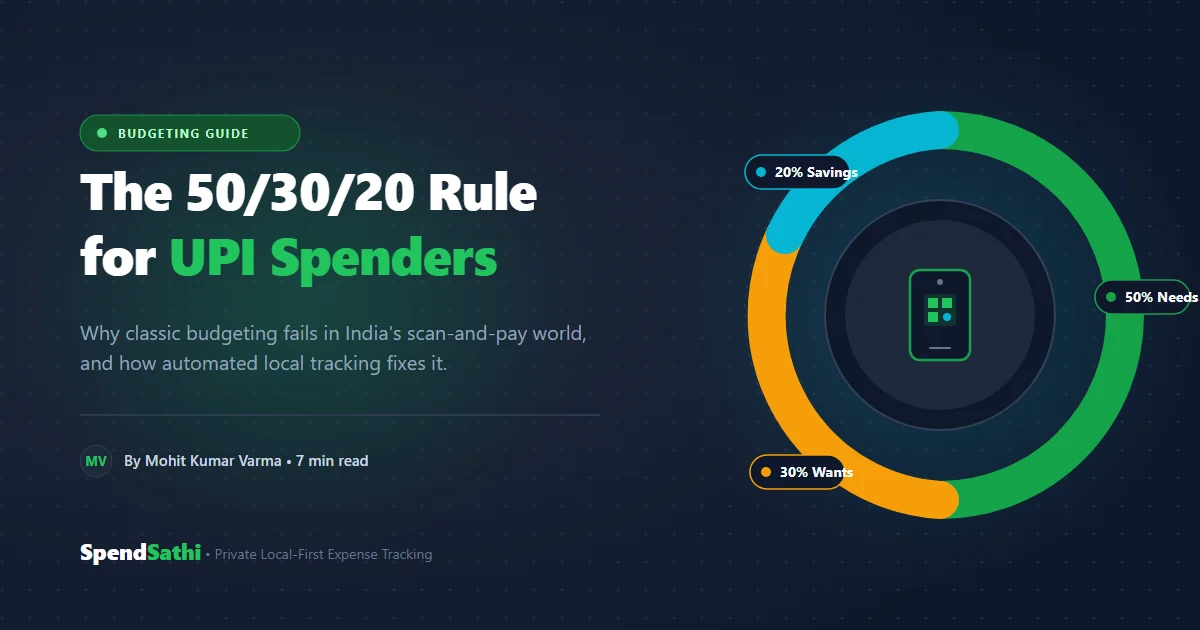
Almost every introductory personal finance book written over the past two decades recommends the same foundational blueprint: Elizabeth Warren’s celebrated 50/30/20 rule.
The math is simple and comforting:
- 50% of your take-home pay goes to Needs (rent, groceries, electricity, basic transit, term insurance).
- 30% of your pay is allocated to Wants (dining out, weekend trips, OTT subscriptions, new sneakers).
- 20% of your pay is funneled straight into Savings and Investments (emergency fund, mutual funds, EPF, PPF).
On a clean spreadsheet, this formula looks indestructible. But if you live in urban India and conduct 90% of your daily commerce through Unified Payments Interface (UPI), you’ve probably noticed an unsettling reality: the 50/30/20 rule rarely survives past the 15th of the month.
Why does a rule that works for millions across the globe disintegrate when applied to an Indian smartphone? And more importantly, how do you adapt it so it actually protects your bank balance?
The UPI Velocity Shock: Why the Classic Framework Collapses
The 50/30/20 rule was conceived in an era of monthly bills, physical checks, and paper banknotes. In that world, money moved with significant physical friction:
- You withdrew cash once or twice a week.
- You paid rent via a single monthly check or bank transfer.
- Every discretionary purchase required handing over physical bills or taking out a credit card and signing a slip.
In modern India, that friction has been reduced to absolute zero.
Between quick-commerce grocery delivery in 10 minutes, ride-hailing apps, neighborhood Kirana QR codes, and digital tipping, the average salaried professional in Mumbai, Bengaluru, or Delhi executes between 80 to 200 micro-transactions every month.
This extreme transaction velocity causes three critical points of failure:
1. The Category Blur (When “Wants” Wear “Needs” Clothing)
When you go to a supermarket once a week and spend ₹3,000 on essentials, it clearly belongs in the 50% “Needs” bucket. But when you place five separate ₹180 orders on a quick-commerce app in a single day for soda, gourmet potato chips, an urgent battery, and late-night ice cream, where does that belong?
Technically, it was ordered under a grocery portal. Psychologically, your brain registers it as “food and groceries” (a Need). In reality, at least 70% of quick-commerce velocity is instant gratification (a Want). Without automated categorization, your 50% bucket silently consumes your 30% bucket.
2. Micro-Transaction Amnesia
A ₹40 chai at the corner stall, a ₹120 parking fee, a ₹60 auto fare top-up, and an ₹85 convenience charge on a train ticket feel completely immaterial in isolation. But compounding ten of these daily across 30 days totals ₹6,000 to ₹9,000 a month—an amount large enough to completely erase your targeted 20% savings quota. Because no single transaction rings an alarm bell, you only discover the deficit when your salary account balance approaches zero.
3. The End-of-Month Autopsy Trap
Most people attempt to fix this by sitting down on the 31st with their bank statement or an Excel sheet. But trying to remember why you sent ₹340 to “Shree Ganesh Enterprises” twenty-four days ago is an exercise in futility. Retrospective budgeting is like driving a car while looking exclusively in the rearview mirror: it tells you where you crashed, but it can’t prevent the collision.
Re-Engineering 50/30/20 for the UPI Era
To make the 50/30/20 system functional when payments happen at the speed of light, you have to replace manual auditing with structural automation. Here is how to rebuild the framework:
┌────────────────────────────────────────────────────────┐
│                   TAKE-HOME INCOME                     │
└───────────┬───────────────────┬───────────────────┬────┘
            │                   │                   │
            ▼                   ▼                   ▼
    ┌───────────────┐   ┌───────────────┐   ┌───────────────┐
    │  50% NEEDS    │   │   30% WANTS   │   │  20% SAVINGS  │
    │  (Fixed Auto) │   │  (Velocity)   │   │  (Day-1 SIP)  │
    └───────────────┘   └───────────────┘   └───────────────┘
Rule #1: Pay Yourself First on Day One (Protect the 20%)
Never treat savings as “whatever happens to be left at the end of the month.” In a cashless environment, nothing is ever left.
The day your salary credits, schedule automated SIPs (Systematic Investment Plans) and recurring transfers for your emergency fund or PPF within 24 hours. Once your 20% is securely locked away, you can spend the remaining 80% without feeling guilty or anxious.
Rule #2: Decouple Your UPI Spending Account
One of the most dangerous habits in India is linking your primary salary or savings account directly to Google Pay, PhonePe, or Paytm. When a merchant scans your phone, they are peering directly into your life savings.
Instead, operate a two-account architecture:
- Account A (Vault): Receives salary. Pays rent, home loan/car EMI, utilities, and investments automatically. Has no UPI apps installed and no debit card carried in your wallet.
- Account B (Spending Wallet): Funded on the 1st of every month with your exact 30% discretionary budget. All QR code scans, food delivery, and retail apps connect exclusively to this account. If the balance hits zero on the 22nd, your UPI spending pauses until next month.
Rule #3: Real-Time Local Aggregation Over Manual Spreadsheets
If your budgeting system requires you to manually unlock an app, select a category, and type “₹45 for chai,” it will fail within ten days. The human cognitive load is simply too high.
The data for every single rupee you spend is already generated instantly by your bank via transaction SMS notifications. What you need is not more willpower, but an engine that reads those notifications the microsecond they hit your phone and maps them into your buckets.
Where SpendSathi Fits: Bringing Privacy to Automation
Most people who search for automated budgeting apps end up downloading tools that demand their Google account logins, read their private email receipts, and sync their banking transaction histories up to remote cloud servers. You trade your personal financial sovereignty for basic convenience.
SpendSathi was built on a different principle: Local-First Privacy.
When your bank sends you an SMS stating that ₹480 was debited via UPI, SpendSathi’s local on-device engine parses the merchant, amount, and timestamp right on your phone:
- Zero Cloud Uploads: Your transaction data is stored in a private Room SQLite database on your device. It never leaves your phone, never touches an external server, and is never sold to credit card aggregators.
- Instant Inbox Zero Review: SpendSathi turns your daily spending into an intuitive swipe queue. You review micro-spends with a single swipe, tagging that ₹180 delivery accurately as a “Want” before memory fades.
- Daily Burn Velocity: Instead of waiting for monthly bank statements, you see your daily spend plotted visually on your calendar, instantly showing if you are running ahead of your 30% discretionary threshold.
The 7-Day Implementation Challenge
Don’t wait for the next financial year to bring sanity to your UPI spending. Start this week:
- Calculate your exact 50%, 30%, and 20% rupee amounts based on last month’s net in-hand salary.
- Set up auto-debit for your investments on the 2nd of the month so the 20% savings bucket is filled before impulse spending begins.
- Install SpendSathi and let its local SMS parser categorize your UPI transactions automatically without sharing your financial life with the cloud.
- Review your review queue every evening for 60 seconds.
The 50/30/20 rule is not dead in India. It just needed an upgrade for the smartphone era.