The Hidden Privacy Cost of Cloud Budgeting Apps: Is 'Free' Worth Your Financial Identity?
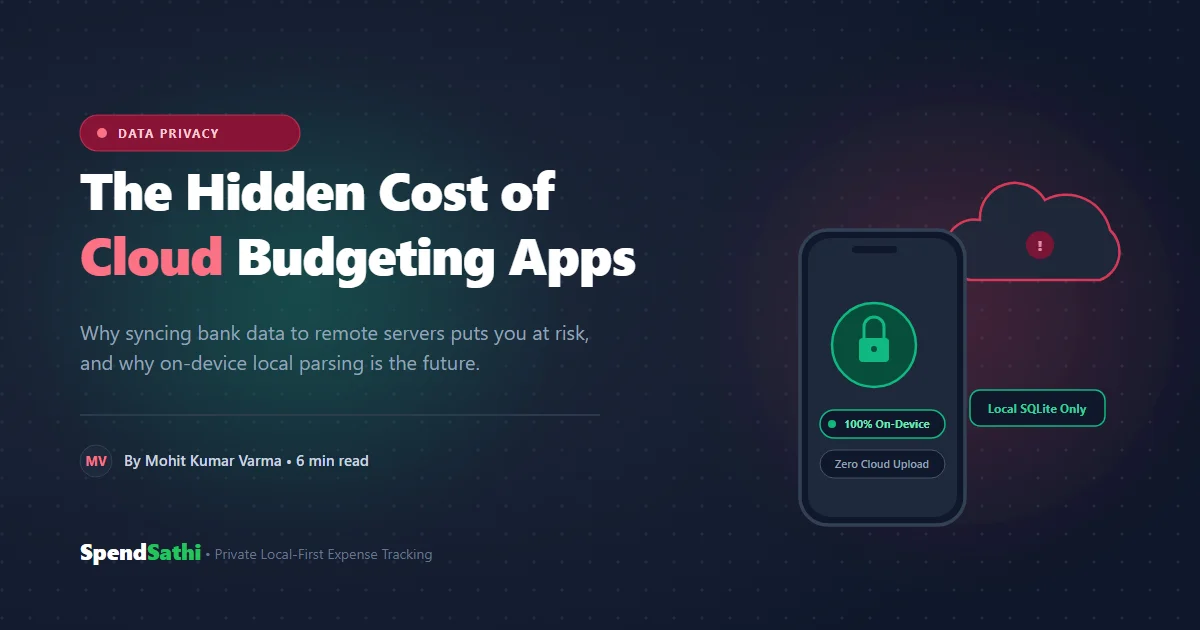
There is an old aphorism in the software world that has never been more relevant than it is in modern consumer fintech: “If you are not paying for the product, you are the product.”
Over the past decade, dozens of slick personal finance and expense-tracking applications have exploded across Android and iOS. They offer beautiful dashboards, net-worth tracking, credit card reward aggregations, and automatic expense categorization. And almost all of them are 100% free to download.
It sounds like a triumph of financial democratization. But building, maintaining, and scaling high-performance mobile applications with millions of active users costs hundreds of thousands of dollars each month in AWS cloud infrastructure, developer salaries, and database licensing.
So how do “free” cloud-based budgeting apps generate millions of dollars in revenue?
The answer lies in the most intimate, sensitive dataset you produce: your complete, unedited transactional financial history.
What Your Bank and UPI SMS Actually Reveal About You
Many people mistakenly believe that expense-tracking apps just read numbers: “Spent ₹350 at Coffee Shop.” They assume this information is harmless and anonymous.
In reality, your financial transaction trail is the highest-resolution digital fingerprint of your personal life that exists. When you grant an application permission to parse your messages and sync them to an external cloud database, you aren’t just sharing amounts. You are sharing:
┌────────────────────────────────────────────────────────┐
│             YOUR TRANSACTIONAL DIGITAL DOSSIER         │
└────────────────────────────────────────────────────────┘
  │
  ├──► EXACT GEOGRAPHY: Where you live, work, and commute
  │
  ├──► HEALTH & MEDICAL: Pharmacies, pathology labs, clinics visited
  │
  ├──► RELATIONSHIPS & SOCIAL: Dating apps, hotel bookings, bars
  │
  ├──► EMOTIONAL BEHAVIOR: Late-night food orders, retail therapy spikes
  │
  └──► COMPLETE BALANCE MAP: Your salary, savings rate, and credit capacity
- Your Exact Health Profile: Transactions at oncology centers, psychiatric clinics, IVF specialists, or recurring prescription purchases at local chemists reveal health conditions you may have never shared with your closest friends or employer.
- Your Daily Geolocation Patterns: The exact times and locations where you scan merchant QR codes construct a precise map of where you live, where you work, which school your children attend, and your weekend travel habits.
- Your Financial Vulnerability Index: Algorithms can detect when your bank balance hits precarious lows, when you delay utility bill payments, or when you take emergency cash advances.
In the hands of data brokers, this is not accounting data—it is a behavioral goldmine.
The Monetization Playbook: How Cloud Finance Apps Profit From You
When your financial profile is synced to a third-party corporate server, it is typically leveraged in three primary ways:
1. High-Margin Credit and Personal Loan Lead Generation
Have you ever noticed that after tracking your expenses on a free cloud app for two months, you suddenly start receiving unsolicited notifications, SMS messages, and emails pitching “Instant Pre-Approved Personal Loans” or “Zero-Annual-Fee Credit Cards”?
That is not a coincidence. The app’s server analyzed your cash flow, identified that your discretionary spending exceeded your balance by 15%, and sold your verified pre-qualification lead to non-banking financial companies (NBFCs) and credit card issuers for hefty commission bounties.
2. Behavioral Profiling and Advertising Retargeting
Even apps that promise in their Terms of Service not to “sell your data” frequently use your transaction categories to build audience segments for third-party programmatic ad networks. Your offline Kirana and dining habits become targetable parameters for multinational consumer brands.
3. Centralized Database Breach Vulnerability
Even assuming the startup behind the app has the noblest intentions, any database that contains the financial records of millions of citizens is an irresistible honeypot for cybercriminals.
Cloud databases are vulnerable to misconfigured Amazon S3 buckets, credential stuffing attacks, rogue internal employees, and sophisticated state-sponsored breaches. When a centralized cloud budgeting service suffers a data leak, your complete banking history, linked phone numbers, and merchant records can end up circulating on dark web marketplaces.
The Account Aggregator (AA) Dilemma
In recent years, the industry has pushed toward Account Aggregator (AA) integrations, promising “secure, consent-based bank data sharing.”
While the AA framework is a massive regulatory leap forward compared to risky screen-scraping techniques, the fundamental architectural risk remains unchanged: once your bank streams your data across the internet to a third-party server, you have lost control over how that data is stored, cached, indexed, and analyzed over a 5-to-10 year horizon.
Consenting to give a company access to your financial feed is easy; revoking and permanently deleting your historical trail from their backups is practically impossible.
The Local-First Revolution: Why Compute Belongs on Your Device
For years, users had to choose between two unacceptable options:
- Option A: Convenient automation that exposes your private financial data to third-party cloud servers.
- Option B: Complete privacy via manual spreadsheets, which takes hours of tedious manual entry and is abandoned within two weeks.
Today, there is a third way: The Local-First Architecture.
Modern Android smartphones contain multi-core processors with specialized neural engines that are vastly more powerful than the supercomputers of the 1990s. There is zero technical justification for sending a 160-character bank SMS alert across the internet to a cloud server just to extract the amount and merchant name.
SpendSathi: Your Financial Fortress
This philosophy is the foundational reason SpendSathi was engineered from day one as a strictly local-first application.
┌────────────────────────────────────────────────────────┐
│              SPENDSATHI LOCAL ARCHITECTURE             │
└────────────────────────────────────────────────────────┘

  [Bank / UPI SMS]
         │
         ▼ (Instant On-Device Read)
  ┌──────────────────────────────────────────────────────┐
  │         SPENDSATHI LOCAL REGEX ENGINE                │
  │     • 0 Milliseconds Cloud Latency                   │
  │     • 0 Data Transmitted to External Servers         │
  └──────────────────┬───────────────────────────────────┘
                     │
                     ▼ (Encrypted Room SQLite)
  ┌──────────────────────────────────────────────────────┐
  │         YOUR PHONE'S LOCAL HARDWARE STORAGE          │
  │     • Protected by Android OS Sandbox                │
  │     • Biometric / Device Lock Secured                │
  └──────────────────────────────────────────────────────┘
- On-Device Regex Parsing: SpendSathi’s parsing engine runs locally inside the Android runtime. When your bank sends an alert for a debit, SpendSathi extracts the amount, tags recurring mandates, and classifies the transaction directly in system memory.
- Encrypted Local Room Database: Your transaction records are committed straight to an encrypted Room SQLite database residing in your phone’s internal application sandbox.
- Zero Telemetry, Zero Cloud Logins: SpendSathi requires no user account, no password, no email address, and no cloud synchronization. If you turn on Airplane Mode, SpendSathi continues to function with 100% parity.
- Zero Server Attack Surface: Because SpendSathi does not maintain a centralized cloud repository of user transactions, there is nothing for hackers to breach, nothing for data brokers to buy, and nothing for advertisers to profile.
How to Audit Your Financial Privacy Right Now
Take five minutes today to audit your smartphone’s financial exposure:
- Review App Permissions: Go to
Android Settings > Privacy > Permission Manager > SMS. Inspect which apps currently have read access to your text messages. If you find photo editors, games, or social apps with SMS access, revoke them immediately. - Check Cloud Sync Settings: Open your current expense or budgeting tracker and look at the settings. Is there a “Syncing to Cloud” or “Logged in as…” screen? Ask yourself where those transaction logs are actually stored and who can read them.
- Switch to Local-First: Download SpendSathi to experience what automated, effortless expense tracking feels like when your data stays exactly where it belongs: on your device, and in your control.
Your financial transactions tell the story of your life, your hard work, and your family’s future. That story belongs to you—not to a corporate server.